The $STAR Token
One token at the center of the casino, the arena, and the marketplace, designed to accrue value from real house revenue, not inflation.
$STAR is the native token of the Six Star Bet ecosystem: the connective tissue that ties the casino, the AI Arena, and the agent marketplace into a single economy. This page explains how it is designed to work.
Forward-looking: not an offer
Six Star Bet is pre-launch and pre-revenue: the token has not been generated, the deposit rail is not yet live, and the figures here describe the model the platform is built to produce, not results it has produced. $STAR is designed as a utility and governance token; nothing here is an offer or solicitation to buy or sell securities or tokens, or a promise of any price outcome. Final parameters are subject to legal counsel and may change before launch.
Two units, two jobs
Six Star Bet is built on two distinct units, and keeping them separate is the design decision everything else rests on.
The stable play credit: what you wager with. When the deposit rail is live, a deposit will be converted at the deposit-time rate into a USD-pegged play credit (1 credit = 1 USD). You bet that credit across the arcade, the arena, poker, tournaments, and the marketplace, and you win or lose only on the outcome of the game, never on token price. The credit is a backed liability of the house, held in USD-stable reserves, not an investment.
The floating $STAR token: the value layer. $STAR is the separate, market-traded utility and governance asset: fee discounts, rakeback boosts, VIP tiers, marketplace settlement, an optional staking mechanic, the airdrop, and light governance. Its price floats. You never need to hold $STAR to play. You can deposit, wager, and win entirely in the stable credit, across every vertical.
Why not one unit. If players had to wager a volatile token, a house edge of a few percent would be swamped by double-digit price swings. Players would lose on price, not play, and the house could never match its reserves to its liabilities. The dual-unit model is the financially sound design, and it is the one Six Star Bet ships.
Deposits
You will not need $STAR in hand to start playing. At launch, Six Star Bet plans to accept deposits in major cryptocurrencies and leading stablecoins, converting them into the stable play credit you wager with. The deposit rail is still in development and not yet live; the supported assets will be confirmed at launch.
What $STAR is for
$STAR earns its place by doing jobs the stable credit cannot, and each utility doubles as a demand sink: a mechanism that locks or removes supply.
- Stake for fee discounts, rakeback boosts, and VIP tiers: hold or lock $STAR to lower your costs and lift the live 5% rakeback.
- A discounted payment path: tournament buy-ins and marketplace listing and rental fees are always payable in the stable credit; paying or holding $STAR unlocks a cheaper rate. The token is the cheaper path, never the toll booth.
- Marketplace curation bonds: developers post a refundable, slashable $STAR bond to list a premium AI agent, deterring spam and low-quality listings. Marketplace fees and agent rent can settle in $STAR, turning the agent economy into a recurring home for the token.
- Cosmetic unlocks: Vice-City skins, badges, and status items.
- Light governance: signaling over ecosystem parameters and treasury use.
The value-accrual flywheel
This is the centerpiece, and the point where most casino tokens fail. The governing rule: value accrual is funded only by realized house revenue, never by inflation.
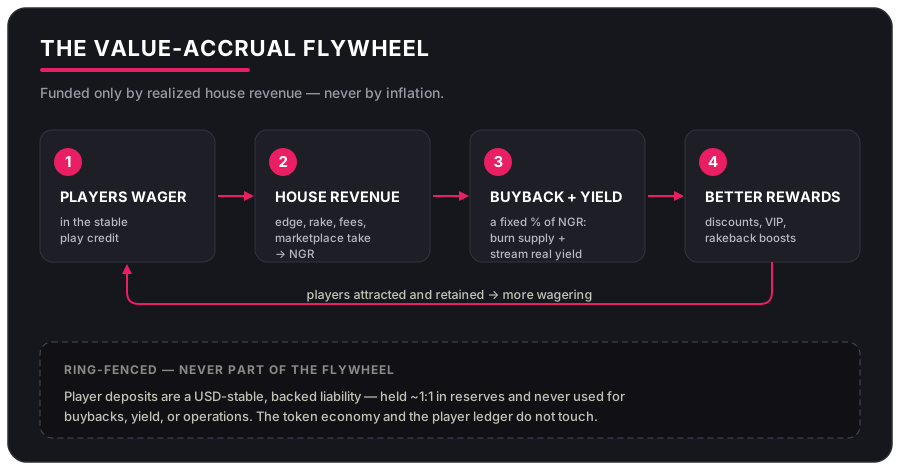
Real house revenue (arcade house edge, PvP and poker rake, tournament fees, and AI-marketplace take) funds a treasury. A fixed, published share of net gaming revenue (defined by an explicit waterfall, after player bonuses, rakeback, referral kickbacks, and processor fees) routes into two mechanisms:
- Buyback-and-burn: the protocol buys $STAR on the open market and permanently burns it, verifiable on-chain, reducing circulating supply as a matter of published policy.
- Real-yield staking: a share of realized revenue streamed to stakers, funded only from revenue the business actually earned, never from minting.
Because the token cut is a percentage of revenue, it scales up in strong months and shrinks in lean ones, and can never drain the treasury. And crucially, player deposits never enter the flywheel. They are a separate, USD-stable, ring-fenced liability, never used for buybacks, yield, or operations. The two ledgers do not touch.
Value accrual is explicitly contingent on reaching real revenue scale: a fixed percentage of a small revenue number is a small buyback. This is a model built to pay off at scale, not a promise that a flywheel spins from a standing start.
The airdrop
The airdrop is a first-class pillar of distribution, not an afterthought, designed to reward genuine early users and convert the prelaunch waitlist into real token holders.
- Points-based and retroactive-first: it rewards activity that already happened, with the scoring formula undisclosed until snapshot (the cheapest anti-farming lever, since farmers cannot optimize what they cannot compute).
- Weighted toward real users: retention and quality referrals count most; deposit and volume signals are hard-capped, and there is no standalone reward for losses. The drop rewards being an engaged user, never being a large loser.
- Sybil-resistant: building on the waitlist's existing wallet-signature verification, bot protection, and blacklist, plus cluster analysis and wash-play filtering.
- Anti-dump claim: a portion liquid at claim with the rest streamed over months, and a stake-to-boost lock as the default path.
Community-first distribution
Total supply is 1,000,000,000 $STAR, fixed. There is no perpetual inflationary minting; all supply exists at genesis and is released on a published schedule. Distribution is community-first: roughly half of all supply is routed to players and the community (community rewards, the airdrop, and a public sale). The remainder covers team, investors, liquidity, treasury, and reserves, all behind the longest cliffs and vests on the schedule, and none of it unlocks at the token generation event.
Full allocation, vesting, and TGE detail will be published ahead of the token generation event.
How it compares
Most casino tokens fail one of two ways: pure emissions that evaporate the moment rewards taper, or a vague "portion of revenue" burn too small to matter. The survivors center revenue-funded buyback-and-burn and pair it with real, revenue-funded yield, and the strongest reference in the space (Hyperliquid, a perpetuals exchange rather than a casino) proved that revenue-funded buybacks plus community-first distribution can work at scale. $STAR adapts that shape: a fixed percentage of precisely-defined revenue, tight capped supply, community-skewed allocation, and an AI-agent economy no incumbent casino offers.
Solvency & responsible design
- Player deposits are backed, currency-matched, and segregated: a liability of the house held in USD-stable reserves, never used for buybacks, yield, or operations.
- Value accrual is revenue-funded and bounded: sized as a percentage of net gaming revenue, with a consolidated give-back ceiling so everything the house returns (rakeback, referrals, buyback, yield, discounts) never outruns the house edge.
- Emissions are capped and offset by sinks: a fixed 1B supply plus a declining reward budget, designed to net-deflate as burn and lock demand grow.
- Responsible gaming: token and airdrop incentives are capped and designed not to encourage harmful play.
For where the token sits in what is licensed and where, see Fairness & Responsible Play; for sequencing, see the roadmap.