The Market
How big online and crypto gambling actually are, who earns in them, and why the numbers are worth reading carefully.
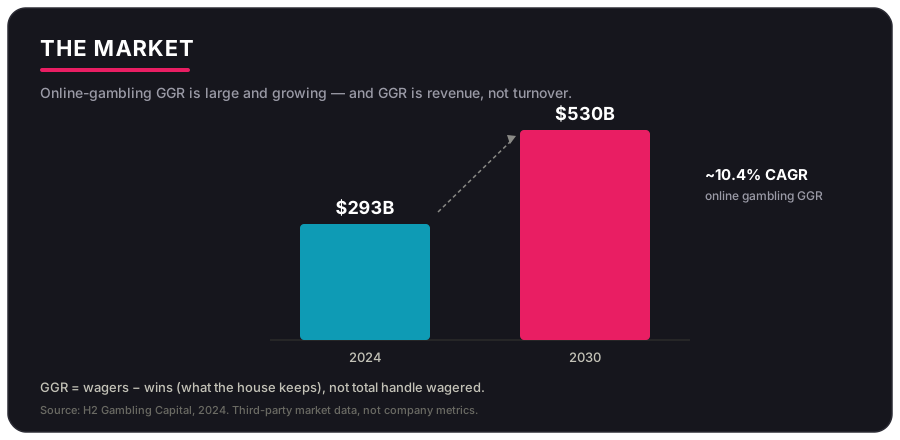
This page sizes the market Six Star Bet operates in. It's written for people doing diligence (investors and builders), so it leads with figures and sources rather than adjectives, and it's honest about where the data is solid and where it isn't. Two things are true at once: online gambling is a very large, fast-growing market, and the crypto slice of it is one of the worst-measured data categories in tech. Both matter, so both are here.
First, how to read these numbers
Gambling figures get quoted loosely, and the same headline number can mean wildly different things. Three terms do most of the damage:
- Handle (also "amount wagered" or "turnover"): the total value of every bet placed. The biggest number.
- GGR (gross gaming revenue): handle minus the winnings paid back to players. This is what operators actually keep, and it's the number market-research firms usually mean by "market size."
- Hold (or margin): GGR as a percentage of handle. It's small: for US sports betting in 2025 it averaged about 10%.
The gap between handle and GGR is enormous. In 2025, US sportsbooks took $166.94 billion in handle but kept $16.96 billion in revenue (roughly a 10× difference), according to the American Gaming Association. Casino games hold differently again. So whenever you see a gambling "market size," the first question is which number is this? The same activity quoted as GGR is many times smaller than quoted as handle.
This matters most in crypto, where (as below) the same $81 billion figure gets reported as GGR by some sources and as amount-wagered by others. Those can't both be right, and the difference is an order of magnitude.
The online gambling market
Estimates from the major research firms cluster in a clear band. For 2025, global online gambling GGR is put at roughly $88 billion (Grand View Research) to $108 billion (Statista), with IMARC, Precedence Research, and Future Market Insights landing in between. All are GGR-based.
Growth is consistently projected in the high single digits to low double digits annually (most firms model a 6–12% CAGR), reaching somewhere around $150–200 billion+ by the early 2030s. Grand View projects ~$153B by 2030; other houses reach $180–255B by 2033–2035. The spread between forecasts is itself a useful signal: nobody has one authoritative number, and methodologies differ.
Within online gambling, casino-type games are the largest or near-largest segment. Mordor Intelligence puts online casino at just over 50% of the market in 2025 and the fastest-growing major category. Sports betting is the other giant.
For a single well-regulated market to anchor against: in the US alone, 2025 commercial gaming revenue hit a record $78.7 billion (AGA). Within that, sports betting revenue grew 22.8% and online casino (iGaming) reached $10.74 billion, up 27.6% year over year, the fastest-growing lines in the entire industry.
Online casino specifically
Sizing the online-casino segment precisely is harder because "online casino" is defined differently across reports. Narrow definitions (Grand View's dedicated online-casino figure) put it near $19 billion in 2024 heading to ~$38 billion by 2030 at a ~12% CAGR; broader "casino share of online gambling" reads land several times higher. Either way the direction is the same: casino is the biggest slice of online gambling and is compounding at double digits, faster than the market as a whole.
The crypto frontier: read with caution
This is the fastest-growing and the least reliably measured part of the market. The honest summary: the growth is real and steep, but the headline totals should be treated as estimates that vary by orders of magnitude, because most of the sector is unlicensed, offshore, and self-reported, with no audited financials and meaningful wash-trading noise.
The range speaks for itself. Estimates of crypto-gambling GGR for roughly the same period run from a few hundred million dollars, to single-digit billions (6Wresearch: ~$6.6B in 2025), up to a widely-cited $81.4 billion for 2024 from gambling-integrity firm Yield Sec, a figure carried by Forbes and the Financial Times, but one that other analysts have publicly called improbable, and that Forbes itself hedged as holding only "assuming the methodology" is sound. That's a ~100–300× spread. Treat any single crypto-gambling total as directional, not precise.
What is better documented is the top of the market. Stake.com, the largest crypto casino, is estimated to have generated around $4.7 billion in GGR in 2024 and to process on the order of $10 billion in bets per month, drawing ~127 million monthly visits, putting a single operator in the revenue tier of major public gambling companies. Even analysts skeptical of the industry-wide totals accept Stake's scale. Other large operators (Shuffle, BC.Game, Rollbit) confirm the top tier is substantial.
A few patterns the sources broadly agree on, source caveats aside:
- Crypto casinos are estimated at ~15–17% of all online-gambling bets globally, up from near zero five years ago. (The firms publishing this often serve the sector: weight accordingly.)
- Bitcoin still carries the majority of crypto-gambling volume (~50–66% by various counts), but stablecoins (USDT/USDC) are the fastest-growing rail, because they remove the price-volatility problem.
- Slots dominate play at ~52–55% of wagers, as they do in fiat casinos.
- Users skew young and male: most counts put 25–34-year-olds as the largest cohort and men at ~70–78%.
- Projections from the higher-estimate camp reach ~$150 billion by 2030: aggressive, and dependent on the disputed baseline, but directionally consistent with every source's "fastest-growing segment" framing.
What this looks like day to day
Annual figures understate how constant the activity is. Converted to simple averages, derived from the sourced annual figures, not directly reported, and ignoring seasonality (which is real; betting spikes around major sporting events):
| Activity | Annual (sourced) | ≈ Per week | ≈ Per day |
|---|---|---|---|
| US sports betting handle, 2025 (AGA) | $166.9B wagered | $3.2B | $457M |
| Global online-gambling GGR, 2025 (mid-range of estimates) | ~$100B kept by operators | ~$1.9B | ~$270M |
| Stake.com alone (reported ~$10B bets/month) | ~$120B wagered | ~$2.3B | ~$330M |
Note the mix of metrics: the first and third rows are amounts wagered; the middle row is operator revenue, which, at typical hold rates, implies billions wagered per day across the global market. The takeaway isn't any one figure. It's that the market runs continuously, at very large scale, every day of the year.
Who earns in this market, besides the house
The house isn't the only economic participant. Online gambling has always routed a meaningful share of its economics to third parties, through channels that are documented and, in places, audited:
Distribution. Operators pay affiliates an ongoing revenue share for the players they bring. Industry-standard deals run 25–45% of net gaming revenue, often for the lifetime of the referred player, with top partners negotiating higher. This is an industry in its own right, not a side hustle: Better Collective, a publicly listed affiliate group, reported €337 million in revenue in 2025 in its audited annual report, and it's one of several listed companies (Catena Media, Gambling.com Group) built entirely on gambling referral economics.
Automation. Wherever on-chain markets offer continuous liquidity, automated strategies follow. Most estimates put algorithmic trading at well over half of all crypto trading volume. In prediction markets, the closest cousin to betting, the pattern is further along: a recent review of Polymarket's public leaderboard found 14 of the 20 most profitable wallets were bots, with arbitrage bots extracting an estimated $40 million in a year from pricing inefficiencies. Autonomous agents earning in betting-shaped markets isn't a forecast; it's already the leaderboard.
Strategy marketplaces. Running someone else's proven strategy for a fee is a mainstream model: industry estimates put 10–20 million people actively copy trading, every major crypto exchange (Binance, Bybit, Bitget, OKX) now ships a strategy marketplace with public track records and leaderboards, and eToro (the original) reported ~35 million registered users in 2025. The mechanic of "public P&L record, rent the strategy, creator earns per activation" is established consumer behavior, not an experiment.
One caveat belongs here, because it's the difference between analysis and hype: none of these channels work by beating the house. House-edge games carry negative expected value for the player, and automating a losing strategy just loses more consistently. Where third parties structurally earn in this industry is distribution share, marketplace and rental fees, and player-versus-player formats where skill matters, the exact channels the companies above are built on.
Six Star Bet's versions of these channels are described elsewhere in these docs: the referral program, the AI Arena, and the agent marketplace. This page makes no claims about their performance; it only documents that these are the established ways money flows to participants, not just operators, in this market.
The shape of it
Online gambling is a ~$90–110 billion (GGR) market growing at double digits. Online casino is its largest and fastest-growing slice. Crypto is the fastest-growing frontier within that, even on conservative estimates. And around the house sits an established earning layer (distribution, automation, strategy marketplaces) that is large enough to support public companies and full-time builders. That is the backdrop against which any on-chain casino operates.
This page makes no claims about Six Star Bet's own performance or projections, only about the size and shape of the market it sits in. Readers draw their own conclusions.
A note on figures
- Figures are current as of mid-2026 and drawn from the sources below.
- "Market size" varies by definition: GGR, handle, and operator revenue are different metrics. This page labels which is which and uses GGR unless stated.
- Crypto-gambling figures are estimates and vary by orders of magnitude between sources. Much of the sector is unlicensed and self-reported, so no figure here should be read as audited unless explicitly noted. Ranges are given rather than single points where possible.
- Daily and weekly figures are simple derived averages (annual ÷ 365 or ÷ 52), not reported numbers.
- Forecasts are third-party projections, not certainties.
Sources
- American Gaming Association: Commercial Gaming Revenue Tracker and State of the Industry 2025 (US commercial gaming; sports handle vs. revenue; iGaming).
- Grand View Research: Online Gambling Market; Online Casino Market.
- Statista: Online Gambling, Worldwide (Market Forecast).
- Mordor Intelligence: Online Gambling Market.
- IMARC Group, Precedence Research, Future Market Insights: Online Gambling Market size and forecasts.
- Yield Sec (via Forbes and the Financial Times): crypto-gambling GGR estimate, 2024.
- 6Wresearch: Crypto Gambling Market Size.
- Public reporting on Stake.com scale (SimilarWeb visit data; industry coverage).
- Better Collective: Annual Report 2025 (audited affiliate revenue); industry guides on gambling affiliate revenue-share terms.
- Industry reporting on Polymarket automated trading (leaderboard analyses of bot profitability and arbitrage extraction, 2025–2026).
- eToro Q2 2025 results; industry estimates of copy-trading participation; exchange-native strategy marketplaces (Binance, Bybit, Bitget, OKX).